If you are sitting there thinking, “Okay, but I don't know any German. What do I do?”
Start at A1.
That's it.
You don't need to think about B2 on your first day.
A1 German
At A1 German, you start with basic vocabulary, pronunciation, simple sentences and everyday expressions. You learn to introduce yourself, ask basic questions and understand familiar information.
The Goethe-Institut describes A1 as the beginner level, where learners can use very basic expressions and interact in simple situations.
A2 German
At A2, you become more comfortable with familiar everyday situations.
You'll work on conversations about work, family, travel, shopping and routines, while gradually improving your grammar and vocabulary.
This is where students usually start feeling that German is becoming a little less foreign.
B1 German
B1 German for Ausbildung is where things become much more practical.
You should be able to communicate more independently, explain situations, give simple reasons for your opinions and handle many situations that may arise at work or in everyday life.
For many students preparing for Ausbildung, this is a major milestone.
B2 German
At B2, you're moving towards more confident and detailed communication. You work with longer texts, more complex conversations, professional vocabulary and discussions where you need to explain and support your ideas.
If your chosen Ausbildung requires B2, or if you are entering a profession where communication is particularly important, this additional level can be very useful.







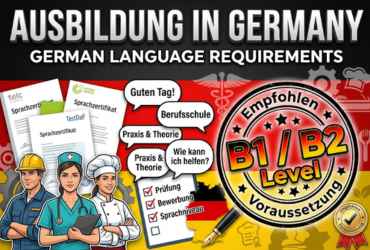 There isn't one language level that works for every Ausbildung. For the Ausbildung visa, B1 is generally the minimum German language level stated by the German government. But your employer, training institution or profession may expect something different.