Updated on Oct, 28 2026 07:59 IST


Test Preprations
About Us
Knowledge Hub

 B2 is where you start expecting much more from your German.
At B1, you can manage a lot of everyday communication.
At B2, the expectation is higher.
You need to understand more detailed conversations, express yourself more clearly and deal with language that is closer to academic and professional situations.
For students planning Germany, this can be an important stage, but again, we would not recommend doing B2 simply because someone says, "Higher German is always better."
Your target should make sense for your actual plan.
At B2, we work on more advanced communication, including:
Longer and more detailed conversations
Expressing and explaining opinions
More complex sentence structures
Reading longer and more difficult texts
Structured writing
Listening to detailed conversations
Professional vocabulary
Discussing different topics confidently
Communicating in academic and workplace situations
You are no longer simply trying to get through a basic conversation.
You should be able to explain what you mean, respond to what someone has said and keep the conversation moving.
At B2, we take the communication skills you've developed at B1 and work towards using German more confidently.
Advanced Speaking & Conversation
At B2, speaking is no longer just about managing familiar everyday situations.
You'll work on expressing your thoughts, explaining your opinions and taking part in longer conversations.
You may not always have the perfect word immediately but that’s okay.
The aim is to become comfortable enough with German to explain yourself.
Listening & Understanding
As your level increases, conversations become more detailed.
At B2, you'll work on understanding longer spoken content and following conversations where people are discussing ideas, opinions or more specific subjects.
This becomes particularly relevant if you're planning to use German in an academic or professional environment.
Reading & Understanding Longer Texts
You'll move beyond simple everyday texts and work with longer and more detailed German material.
The focus is not only on understanding individual words.
You also need to understand the overall meaning, identify important information and follow what the writer is trying to communicate.
Structured Writing
Writing at B2 requires more than putting sentences together correctly.
You'll work on expressing ideas clearly, organising your writing and communicating your thoughts in a structured way.
This is particularly useful for students who need stronger German for academic or professional situations.
Grammar & Sentence Structure
B2 involves more complex grammar and sentence structures.
But again, we don't want you learning grammar simply for the sake of completing grammar exercises.
The purpose is to help you communicate more precisely and understand more complex German when you hear or read it.
Vocabulary for Academic & Professional Situations
At this stage, basic everyday vocabulary isn't enough.
You'll gradually build vocabulary that helps you discuss more detailed topics and communicate in situations that are closer to academic and professional life.
The exact vocabulary you need can also depend on your area of interest.
Practical Communication
Finally, we bring these skills together.
You'll practise discussing different topics, explaining your views, responding to other people's ideas and communicating with greater confidence.
The goal is not to make every sentence perfect.
The goal is to make your German usable when the conversation becomes more demanding.
B2 can be particularly relevant for students looking at nursing, healthcare and other professions where communication is a major part of the job.
Think about what actually happens in a healthcare environment.
You're not only reading or writing. You're speaking with colleagues, understanding instructions and communicating with patients.
That requires much more than knowing a list of German words.
However, the exact language requirement can vary depending on the programme, employer and recognition or professional requirements involved.
So we always recommend checking the specific pathway rather than assuming B2 is automatically required everywhere.
Students planning university, professional work or other longer-term opportunities in Germany may also benefit from B2-level communication.
At this stage, you are dealing with more detailed information and are expected to communicate your thoughts with greater clarity.
This is also where vocabulary becomes much more important.
You need to move beyond basic everyday German and start becoming comfortable with the kind of language used in your particular area of interest.
If your goal is a B2 certificate, don't leave exam preparation until the last few days.
You can know quite a lot of German and still lose marks because you haven't practised the exam format properly.
The reading, listening, writing and speaking sections each require a slightly different approach.
That's why we separate general German learning from focused exam preparation.
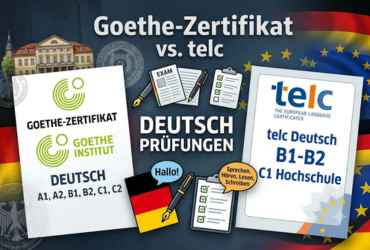
If you're specifically preparing for a Goethe or telc B2 examination, Anigdha also provides dedicated exam preparation support.
That preparation is different from your regular B2 German course because the focus is on understanding the examination, practising the relevant sections and identifying where you need more work.
B2 may be suitable if:
You've completed B1
You can communicate reasonably comfortably in German
You want to develop more advanced communication
Your study or career pathway requires B2
You're preparing for a B2-level German examination
You need stronger German for academic or professional situations
If you're unsure whether you're actually ready for B2, don't judge yourself only by how many grammar chapters you've completed.
Your ability to understand and communicate matters too.
A quick assessment of your current German can tell us much more about whether you're ready to move from B1 to B2.
For many students, B2 is an important milestone because it takes their German beyond everyday communication and towards more academic and professional use.
But what comes next depends on what you're planning to do in Germany.
You may be preparing for a specific examination, university pathway, professional requirement or career.
So don't automatically assume that you need another level simply because you've completed B2.
First look at the requirement for your actual plan.
Therefore, B2 level German is an upper intermediate or an advanced level course which includes complex situations and practices. This is often famous among employees or people who want to work in Germany. It ultimately increases your profile and makes you compatible for every job option and internship. If you are really interested in getting the proper support, we are eager to assist you.
Reach out to us today and get the right guidance!