-
Choose A Correct University: Now that a student has made the decision to study in Denmark, it is time to choose the ideal university and the perfect course. Five universities in Denmark make up the top 4000 in the world ranking. Some of the other featured universities in Denmark are Aarhus University, Technical University of Denmark, University of Southern Denmark, and Aalborg University. To find the appropriate course for students, you need to go through the programs offered by various universities in Denmark. Once the student finds the ideal course, it will be easy to find the best universities in Denmark to study for his desired degree.
-
Go Through The Requirements: At this stage, students will decide on both the university and the course. Before applying, students need to go through the qualifications and whether the specific university recognizes them or not. To be eligible for the Danish university, the student's qualification must be equivalent to the upper secondary school leaving certificate of Denmark. For certain undergraduate programs, but for certain undergraduate programs, any relevant vocational qualifications are sufficient. Some courses need additional requirements for admission. If the students do not meet all the requirements, it is better to take the supplementary course. The supplementary courses will make the students eligible for admission. But these courses will certainly not increase the GPA score.
-
Language Skills: Many non-danish applicants can easily apply for study programs that are taught in English. To study a particular course in English, students need to submit proof of an English proficiency exam that is equivalent to level B of English in Denmark. The exact scores will be stated by the universities. If students are applying to study a course in Danish, they need to pass the Danish language test. It will help to prove the proficiency level in the language. Students can either take Danish as a foreign language or Danish Test 2.
-
Funding And Fees: Students from both EEA/EU and Switzerland Denmark provide higher education free of cost for both the postgraduate and undergraduate courses. If candidates are not from EAA/EU, candidates need to pay the tuition fees to the Danish universities. On average, it usually costs US $8000 to $21,000 every year.
-
Apply: Applications to pursue education in Denmark should be through some national admission sites. In the sites, you will apply to the universities that you wish to apply for.
-
Signature: To apply to the universities, candidates must provide a signature and verify the ID for every course. If a candidate holds a residence permit or is a Danish citizen, it must be done with NemID. It is a digital identification tool that was issued to the candidate previously. In case a candidate is from overseas, the candidate will be required to print the signature page, sign the page, and send it to the specific university to which he/she is applying. The signature page will have an application ID from where the universities will download the application of the candidates.
-
Other Documents: Students need to submit a diploma in upper secondary education. The submission must be made in the attachments section of the application. It is sometimes also required to attach a personal essay, but it solely depends upon the university and the course.
-
Apply For Courses And Receive Responses: Students can apply for eight programs. The students need to list the programs according to their priorities. Each of the applications applied by the student must contain a signature in it. After that, students will receive a single response from the university. The response will be in the form of a letter
-
Get The Health Insurance: Once the student has accepted the offer from the university, it is the ideal time to sort out an essential part when you are preparing to study abroad. Overseas students need to purchase travel insurance coverage for the duration they need to study in Denmark.
-
Obtain The Visa: Students who are a citizen of Sweden, Finland, or Norway, do not require any documentation to work, study and live in Denmark. All that the candidate needs is the Danish personal identification number. In case the student is from the EEA/EU or Switzerland, he or she can live and work in Denmark for three months without any documentation. After three months are over, students need to get the Danish registration certificate. And if the student is from outside the EEA/EU or Switzerland, he or she needs to obtain a residence permit in case the duration of studies is more than three months. If the student is staying for less than three months, then it is mandatory to have a tourist visa.
-
Sort Out Accommodation: Once the students have the visa, it is time to arrange for accommodation. 9. Enroll Just before you start your course, you will need to enroll in your university. This is done online, and there will be information sent by your university just before you start about how to do this.







 Denmark is one of the popular destinations for international study in Europe. It is popular because of a lot of reasons, such as the high-quality master’s degree taught in English, low study costs, and, most importantly, innovative methods of teaching. Overseas students also choose Denmark due to the large variety of study subjects and the excellent standard of living available at Danish universities. The Danish education system promotes innovation, creativity, and critical and analytical thinking. The higher education institutes in Denmark will help the students to learn from industry experts and let the students do an internship with well-recognized organizations. On the other hand, Denmark will also make the students study in a friendly, safe, and innovation-driven environment. In this country, higher education primarily focuses on bringing solutions to real-world issues. Therefore, the institutions combine traditional lectures with teaching methods and industrial collaborations to promote students’ ability to make use of what students have learned and turn new knowledge into an innovative solution. Also, a global partnership between businesses, higher education institutions, public research institutes, and science parks ensures that research and study in Denmark help to reflect the latest knowledge. It also meets the global labor market’s needs. 85% of the students studying in Denmark get world-class class exposure after completing their degree.
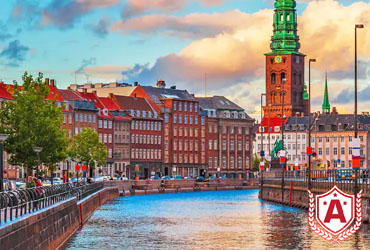 Denmark is a very small country with 5.5 million as its population. Denmark is one of the three Scandinavian countries. The people in Denmark are known as Danes. The Danes are known to be the happiest people in the world. The Danish welfare system offers all citizens equal and free rights to benefits such as education and healthcare. There is strong economic equality in the society, low crime rates, and no corruption in Denmark. Providing free education is the key priority in Denmark. Competitiveness, growth, and welfare are highly ensured in the country. Being practically an island nation, Denmark has 406 islands. Copenhagen is the capital of Denmark. Everywhere in Denmark is about 50 km from the seaside.